*** PLEASE VISIT OUR NEW AND IMPROVED NEWS WEBSITE. CLICK HERE
Showing posts with label hotel rooms. Show all posts

Thursday, August 25, 2011

Drunken Politican Trashes Hotel Room

Anchorage Daily News: Wasilla City Councilman Steve Menard (right) is apologizing but will not resign after the city was billed for a Sitka hotel room that Menard apparently drunkenly trashed while on city business.

The Wasilla City Council is requiring Menard to pay the city back the entire cost of his trip to Sitka and forbidding him from any more travel on city business until his term expires in October 2013.

Menard was staying at the Westmark in Sitka earlier this month for a meeting of the Alaska Municipal League. The hotel reported that damage to his room included urine on two mattresses and a chair, vomit on the carpet, ruined bedding, and a burned mattress. It's not clear exactly how it was burned but the hotel bill said there had been smoking in what was a non-smoking room.

The Wasilla City Council met in a closed session at the end of its regular meeting Monday night to decide what to do about it. Before the session began, Menard gave a brief statement, according to an audio recording provided by the city.

"I would like to start off by ..." he began, followed by a long pause. When he resumed his voice was breaking slightly. "Apologizing publicly for my actions in Sitka. The City of Wasilla, my friends and family, I'm truly embarrassed and sorry, truly sorry."

“I sit here before you a humbled man 11 days sober and working a program. And only through the grace of God I will redeem myself. And I thank you," he said.

Menard is a member of one of the best known and most influential families in the Mat-Su. His mother, Linda Menard, is a state senator who represents Wasilla. His father, Curt Menard, was a longtime state legislator and friend of the Palin family who was serving as the Matanuska-Susitna Borough mayor when he died in 2009 after an extended battle with cancer.

Then-Gov. Sarah Palin appointed Steve Menard to fill out his father's term on the Alaska Railroad's board of directors. He is no longer on the railroad board but Gov. Sean Parnell last year appointed him to a public seat on the Alaska Royalty Oil and Gas Development Advisory Board for a term that expires in 2015.

The board does not meet often and hasn't since 2004. It reviews new contracts between the state and refiners for purchase of royalty oil, the state's share of the crude produced on state lands.

Menard, who did not return messages from the Daily News, is a waiter at Evangelo's Restaurant in Wasilla, according to his October 2010 filing with the Alaska Public Offices Commission and a Tuesday interview with a fellow council member, Dianne Woodruff.

Menard had worked in the administration of then-Gov. Palin as an administrative assistant to Palin and later a special assistant to the labor commissioner. Menard was on the Wasilla City Council from 2005 to 2008, before running unsuccessfully for mayor.

He won another city council term last year. The Mat-Su Valley Frontiersman editorialized that Menard should admit that he needs help as well as resign from the council after what happened in Sitka. And Wasilla resident John Dewar told the council at Monday night's meeting that he believed Menard was "not fit for public office."

But Anne Kilkenny of Wasilla, who gained national attention in 2008 when her long email casting doubt on Palin's leadership went viral on the Internet, urged the city council on Monday night to show compassion for Menard.

"I ask you, who among you is without sin? Let him be the first to cast the stone. If your goal is to protect and preserve the good reputation of the City of Wasilla then I suggest that you look at enacting an ordinance which forbids the consumption of any quantity of alcohol while on city business," she said.

The Westmark Sitka sent the city of Wasilla a $350 bill for repairs to Menard's room. Westmark Hotel manager Kathy Adams would not comment on Tuesday.

She'd earlier told the Frontiersman that "we actually went light on the charges" and that the room was out of service for three days as a result of what happened. She said her housekeeping manager wanted to charge for new beds.

Adams had told the Frontiersman that Menard had told the hotel to "bill it to the city" and that the Westmark was on the verge of calling the police because the city initially would not pay the $350. The city decided to pay and had Menard reimburse the cost.

The City Council on Monday night directed Menard to also pay back to the city the entire $1,404 cost for him to attend the Sitka meeting, which other Wasilla council members attended as well.

The council also won't allow Menard to travel on city business for the remainder of his term.

Menard has declined to describe exactly what happened in Sitka. He has had documented difficulties with alcohol in the past. Menard was convicted in 2004 for driving under the influence in Fairbanks and in 2007 in Anchorage on a charge of "drunk on licensed premise." He told the Daily News while running for mayor in 2008 that he'd addressed the issue by no longer drinking.

Fellow Wasilla council member Woodruff said in a Tuesday interview that Menard "is a person with an issue and hopefully this will get him the help that he needs." Woodruff said she believes that Menard is now involved in Alcoholics Anonymous.

Woodruff, an outspoken critic of Menard's former boss, Palin, said she has always found Menard to be a good council member.

"He has come up with a lot of good ideas for the city and he's passed some meaningful legislation. I've never seen him do anything that I thought was self-serving, that wasn't meant for the good of the community. So I'm hoping this is a reasonable solution in which he's been properly sanctioned and gets the help he needs and the city benefits still from his expertise," Woodruff said.

Wednesday, August 24, 2011

Hotel Room Bugaboos

New York Times: And you thought all you had to worry about when you checked into a hotel was bedbugs.

On Page 18 in the Manhattan district attorney’s filing recommending dismissal of the sexual assault charges against Dominique Strauss-Kahn was a detail that was disquieting if not disturbing: In his $3,000-a-night hotel suite, detectives found semen stains on the carpet and the wallpaper from other men.

“That is not a surprise to me,” said Lawrence Kobilinsky, the chairman of the department of sciences at John Jay College of Criminal Justice, who has done forensic work in places like hotel rooms. “People think when they go to a hotel, they’ve got a nice, clean pristine place to stay. I did a study in hotel rooms with UV lamps and I found stains all over the place, not just on floors and furniture but on bedding, the linen, the bedspreads. I found it all over the place.”

In sum, he said: “You know you’re not getting a sterile environment when you check into a hotel.”

It is enough to make some say they would never stay in a hotel room again.

Some of Dr. Kobilinsky’s discoveries might be enough to make them stay out of a lot of places, too. Movie theaters, for example. “I went into movie theaters in various places within New York City,” he said, “and I found dried semen samples on the seats. And I had to do it surreptitiously with a hidden camera to document what I had seen.”

But back to what detectives found in Mr. Strauss-Kahn’s suite at the Sofitel New York, on West 44th Street, where a 33-year-old housekeeper said she had been sexually assaulted.

“It’s a forensic fact that when you go in and look at a crime scene in a hotel,” Dr. Kobilinsky said, “you’ve got to be careful interpreting what you see.” There could be “historical DNA,” he said, that is, DNA from the room’s previous occupants.

That, apparently, was the case when detectives began going through Mr. Strauss-Kahn’s suite.

Three stains on the carpet “contained the semen and DNA of three different unknown males,” according to the filing recommending dismissal of the charges against Mr. Strauss-Kahn, “and one other stain contained amylase and a mixture of DNA from three additional individuals.” Amylase, the filing explained in a footnote, is “an enzyme found in semen, saliva and in other bodily fluids, including vaginal fluid.”

There was also a stain on a section of wallpaper, the filing said. It “contained the semen and DNA of a fourth unknown male.”

Dr. Kobilinsky he was not surprised that the police found DNA in the suite that did not match Mr. Strauss-Kahn’s. “Who knows how old those stains are?” he said. “DNA is a pretty sturdy molecule. It doesn’t deteriorate that readily, and not from aging. It is true that certain bacteria or fungi can break down DNA and certain types of soil can break down DNA, but normally it’s in a place where it’s not being assaulted, so to speak, by environmental factors, it survives. So it could be a day, a week or a month old, or possibly older.”

Vacuuming a rug, as hotel housekeepers routinely do, would not normally destroy the DNA, he said.

But what about subsequent guests?

“The chances are minimal that you’re going to become infected with some agent present in semen, not that it’s impossible,” he said. “But viral substances will survive several days unless something intercedes. H.I.V., for example, will survive under those conditions for at least four or five days. But the chances of somebody coming down with an infectious disease are almost zero.”

Thursday, July 28, 2011

London Hotel to Have "Floating" Rooms

Click to Enlarge
TheSun: Premier Inn (plans) to build the UK's first hotel with floating bedrooms. The hotel in London's Leicester Square will feature 84 bedrooms which "float" on neoprene pads to deaden noise from the square and a club below.

Walls and ceilings will be insulated and windows quadruple-glazed.

Patrick Dempsey, managing director of parent company Whitbread, said: "It means we can be confident about guaranteeing a good night's sleep, even in the heart of one of the world's liveliest entertainment centres."

The hotel is scheduled to open next February.

Sunday, July 24, 2011

Staying Connected When You Go

Vegas Chatter: In today's world of cellphones, laptops, and tablets you can always stay connected wherever you go and when you check-in to the Tower Suites at the Wynn Las Vegas, the 24-hour news cycle is there to greet you...at the urinal.

We found this photo from TomBarnes20008 in our big sister, HotelChatter's Flickr pool which was taken inside the men's room of the dedicated Tower Suites check-in area. Why someone needs a TV while they are urinating is beyond us. After all, how long does that take? Max three minutes? Maybe four if you have too much beer? Will you even catch your stock on the ticker in time?

Then again, this is Vegas, a city practically built on ridiculuxe items. And we wouldn't change it for the world. However, what would you prefer? TVs above the urinals or a toilet seat that rises to greet you?

Tuesday, July 19, 2011

Hotel Minibars Becoming Healthier

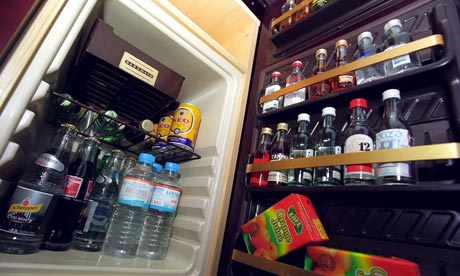
MarketWatch: Hotels and resorts are increasingly stocking minibars with healthier alternatives to traditional high-fat, high-sugar snacks — a boon to business and leisure travelers as well as the hospitality industry.

At the Hyatt Hotels Corp.-owned Andaz Wall Street in New York, minibars are stocked with organic Clif Bars and Terra plain and vegetable natural chips. This summer, the Four Seasons Hotel Austin in Texas will test the sales of six organic, healthy and/or locally-produced products, including peeled mango, ginger tea and nut-and-fruit gluten-free energy bars.

Three out of four in-room snack-box choices in Loews Hotels include low-fat items such as trail mix, cashews and honey-wheat pretzels. The trail mix and cashews outsell the chocolate cookies, and Fiji Water is the minibar’s most popular item at the Loews Coronado Bay Resort in San Diego, said Adam Martindale, the resort’s director of food and beverage.

Minibars were once mostly a collection of high-fat, sugary impulse treats like chips, cookies, sodas, plus alcoholic beverages. While those items won’t be disappearing, travelers — particularly business travelers with a hectic schedule — will notice changes for the better when it comes to in-room convenience options.

Hotels with minibars increasingly offer at least one or two healthier choices, and nuts are the most popular, said Matthew Jones, director of West Coast operations for In-Room West, a subsidiary of In-Room Plus which stocks minibars in hundreds of hotels nationwide and globally.

Supporting the amenity approach, minibars themselves have not been big moneymakers for hotels, accounting for less than 1% of total hotel revenues in 2010, said Robert Mandelbaum, director of research information services for PKF Hospitality Research, which tracks hotel trends. Many guests are reluctant to pay typically steep mark-ups for snack items, but customizing in-room offerings can create an additional incentive to buy, he said.

The demand for healthier minibar snacks has been growing slower than the consumer market might predict, said Alvaro Garza, founder and president of the Dallas, Texas-based Healthy Minibar, which specializes in all-natural snack products. Healthy Minibar has attracted 42 hotel clients including the Four Seasons Hotel Austin during the past few years, but the biggest challenge has been educating hotels about the demand for and health benefits of natural snack food products, he said.

“Even though success may not be immediate, hotels are going to need that support to make the transition towards ‘better for you’ [food],” Garza said.

Hyatt Regency and Grand Hyatt hotels have mostly removed in-room minibars, but some of the properties in more health-conscious markets are selling trail mixes and similar snacks in lobby grab-and-go markets, said Katie Rackoff, a Hyatt Hotels spokeswoman.

Boatel: Hotel Rooms That Float

New York Daily News: For just $50, you can spend a night at the "boatel" that just opened in Far Rockaway (NY).

Yes, the 30-foot-long motorboats converted into floating hotel rooms have some drawbacks: Light is provided by citronella candles, jets taking off from JFK across Jamaica Bay can be deafening and it's a long walk down the dock to Marina 59's bathroom and showering facilities.

So, of course, the place is sold out for July. And August. And through Labor Day - though it may extend the season and add additional weekdays to its Thursday-Saturday availability.

"I'm not trying to bring Burning Man to Far Rockaway," insists 29-year-old Constance Hockaday, the Texas native behind the project. "I just wanted it to be adventurous enough so that when you were stepping off of that dock and onto this dock it feels like you're in a different place."

Mission accomplished. Hockaday and a crew of volunteers spent a month renovating four abandoned fiberglass motorboats at the marina, which are now tied to a floating platform with a frame for an 8-foot-by-12-foot movie screen.

If you're going to make a boatel, why not throw in a "boat-in" movie theater?

The fifth boat in the boatel, a 1967 houseboat described online as a "down-home love nest," can sleep up to five and is named after a 19th-century madame named Nancy Boggs, who ran a floating brothel on the Wilamette River in Oregon. The renovated houseboat, which comes with a deer head mounted on an interior wall, goes for $100 a night.

"I did throw around the idea of creating a floating brothel but I don't know if I'm quite madame material," Hockaday says with a straight face.

Hockaday grew up in Port Isabel, Tex., and earned a bachelor's degree in Participatory Community Development in Oregon. When she was 19, Hockaday spent time with the Floating Neutrinos, a bohemian family who sailed a houseboat made of junk around the Northern Hemisphere.

In 1998 the Neutrinos clashed with New York State authorities over their right to anchor the funky floating home in the Hudson River off of Chambers St. That summer they sailed for 60 days from Newfoundland to Castletownbere, Ireland. They were aiming for France.

Four humans, three dogs and a piano survived a Force 9 gale during the transatlantic voyage. Hockaday cites the Neutrinos as a major influence on her worldview.

It's a worldview with a heavy dose of Do-It-Yourself attitude. Although the hammer-wielding woman is reported to have spent $2,000 on the boatel, she collected lumber in dumpsters around Queens and Brooklyn for the project. Building and decorating supplies were donated by Build It Green NYC and Materials for the Arts, two non-profits who helped, thanks to Flux Factory, a Long Island City-based arts group.

The boatel is part of Seaworthy, Flux Factory's series of exhibitions, installations and boat trips celebrating the city's marine heritage. Flux Factory also introduced Hockaday to the owner of Marina 59, Ari Zablozki, who was eager to donate fiberglass motor boat hulls. The marina, like so many other around the country, is plagued by tenants abandoning their boats, which cost several hundred dollars each to have junked.

"People abandon their boasts very quickly," says Zablozki. "When I took over a year and a half ago, there was about 90 junk boats piled on top of each other in the back. It's horrible."

Zablozki is determined to transform the marina, which is mostly used by working-class fishermen.

A project on the website Kickstarter has raised more than $12,000 for an art gallery and performance space that is being made out of two shipping containers at the marina. A houseboat known as Jerko, which is used for workshops on rainwater harvesting and building solar panels, is anchored within a few yards of the boatel.

The DIY vibe appeals to Rob Bryn, a 34-year-old musician who sublet his apartment in Williamsburg and is spending the summer in one of Zablozki's abandoned fiberglass hulls. Bryn's "floating cabin" is on a dock adjacent to the boatel, which he thinks is a worthy concept.

"The economy being what it is, this is a vacation spot that's a subway ride away," said Bryn. "I think the fact that people can come down here and get acquainted with this place is great."

Not everyone in the neighborhood thinks the boatel makes sense. When informed of the project last week, David Giles, who lives eight blocks away, was incredulous. "All I can say is that something needs to be done about that."

The marina and Flux Factory have made sure they have a legal life preserver of sorts.
Boatel guests are required to sign a liability waiver and they get a letter informing them that the boatel is "not a real hotel. This is an adventure at best and an art project at worst."

Saturday, July 16, 2011

The Pop-Up Hotel Room

The Telegraph: This is a one-off, I must admit, but I thought you might find the concept useful if you plan to become one of the million-plus people who will attend a festival this summer. You've heard of pop-up bars and pop-up restaurants – they are all the rage. Now here's a pop-up hotel room.

Oh yes. A company called All About Space has come up with the idea and has, or is rolling out their podules at festivals across the country, including Glastonbury, T in the Park, Kendal Calling and the British Grand Prix. Their first outing was at the Hay Festival and on behalf of the Telegraph, the festival's sponsors, I went to test one.

Luxury camping in yurts and tepees has been a feature at festivals for years now, but the owners of All About Space saw a real gap in the market for easily erected temporary accommodation with the amenities of a hotel bedroom that a mere tent cannot provide, including thermal and acoustic insulation, heating, air conditioning, plug sockets, flat-screen television, en-suite power shower and loo. Plus coat hangers and shelves, full-length mirror, dual radio and iPod dock, mini fridge and, perhaps most importantly, a decent bed.

"Quite simply the biggest leap forward in festival accommodation since the invention of the tent," claimed the press release, and about its impressive list of facilities it did not lie.

If only the podule's looks and character matched its facilities. Tepees, yurts, gipsy caravans and the like may lack mod cons but they do have charm. A podule, on the other hand, does not.

As I drove towards Hay through lovely lush countryside full of meadows and abrupt little hills I fondly imagined my pop-up haven, having been promised all the allure of a "boutique" hotel bedroom. In the event, I found a field belonging to an amusingly quirky and old-fashioned hotel, Baskerville Hall, two miles from Hay, and in the field I found a semicircle of Portaloos – sorry, podules – looking, well, awfully like the former, and rather forlorn.

They have all the allure of a metal container, which is what they are: 129 square feet of compact oblong metal box, raised off the ground for extra protection from the elements. If you've stayed in a Japanese pod hotel, or Yotel at Gatwick or Heathrow, you'll know the score and you'll know just how much can be fitted in.

There's even a table and chairs in the space between the door and the bed, with a kettle and tea things. There is no window as such, but you can see out through a glass panel beside the front door.

At the rear of the cabin is the tiny – and I mean tiny – shower and lavatory area. But the water was piping hot and the pressure high. Sheets and towels were excellent, the four-foot bed comfortable. There was no signal for the television above the bed, but that was hardly a problem: a television at a festival feels rather decadent.

As for my time in the podule, I emerged clean, tidy, washed and rested, if not enamoured of the experience.
But it was certainly the last word in metal containers.

How it rates

ROOMS (out of five) TTTT
Much warmer, drier and better equipped than a tent

SERVICE TT
You get the hotel bedroom but not the hotel service

CHARACTER TTT
It's a metal container – plenty of facilities, yes; character: non existent

FOOD & DRINK TT
Tea, coffee, biscuits, fresh milk and bottled water provided in mini fridge

VALUE FOR MONEY TTT
Despite facilities, expensive for a box

Tuesday, July 12, 2011

Anti-Snoring Hotel Rooms

USA Today: They're on the way from Crowne Plaza.

The chain says the "Snore Absorption Rooms" are a result of research showing that the non-snoring half of a couple can lose one or more hours of sleep a night due to their partner's habit. According to the hotel chain's website, a United Kingdom survey says that three in 10 couples have come close to splitting up because snoring is an issue and that 50% of UK couples complain their partner's snoring can ruin vacations.

Here's what's in the room, according to Crowne Plaza:

•Soundproofing on walls to absorb loud frequencies and reduce noise reverberating in the room.

•A sound-absorbing headboard to help muffle the snoring echo within the room.

•An anti-snoring bed wedge that encourages snorers to sleep on their sides or upright instead of flat on their backs, which worsens snoring.

•An anti-snoring pillow which uses magnets to create a magnetic field that is supposed to open the airways and stiffen the upper palate, so it won't vibrate and encourage snoring.

•A white noise machine to help drown out the snorer.

I have another suggestion: earplugs in the amenity kit for the snorer's partner. I still think it's near impossible to drown out a snorer next to you who is capable of being heard throughout a house. But this will be great news for those who have been put in a hotel room next to a champion snorer.

According to a report in The Seattle Times, the "snore absorption" room is being tested at Crowne Plaza hotels in Europe and the Middle East. A Crowne Plaza spokeswoman tells USA TODAY that there currently are no plans to bring the rooms to the United States.

Friday, June 24, 2011

Suspects Posted Hotel Damage on Twitter

Charleston Gazette: South Charleston police have arrested six people over the past two days, after photos of them destroying a hotel room and spa area at a South Charleston motel were posted on the Twitter social networking website.

Drew Korsen, Nathan Brown, Michael Adkins, Jason Boyle, Gregory Shane Barnes and Jesse Nunley have been arrested on felony charges of destruction of property, South Charleston Police Officer E.M. Peterson said. Their ages and hometowns were not immediately available.

Police expect to arrest at least two more in the next few days. Two juveniles also were involved in the incident, Peterson said. All of the suspects are between the ages of 16 and 23.

At about 10:30 a.m. Monday, workers at the Wingate Inn told police that the men had destroyed a hotel room and spa area at the hotel and caused about $13,885 in damage, according to a criminal complaint filed in Kanawha County Magistrate Court. That total does not include damage the men had allegedly done to the hotel's sprinkler system, the complaint states.

The men had apparently rented the room to party, Peterson said. Two females had been in the room for the party, but left after the men started destroying things, he said.

Three of the suspects -- Korsen, Boyle, and a man who has not yet been arrested -- wrote messages back and forth on Twitter as they destroyed the hotel room, and posted pictures of the carnage along the way, Peterson said.

Almost all of the partygoers were shown in the photographs, which police then used to make the arrests, Peterson said.

"These kids handed me this case," he said.

Because the destroyed property is valued at more than $2,500, the men have been charged with felonies, Peterson said. He did not say how the property was destroyed.

Of the six men arrested so far, four had been released on bond as of Wednesday evening. Brown and Boyle remained in jail.

Wednesday, June 22, 2011

Tall Headboards: Trendy or Fugly?

Hotel Chatter: Let's talk hotel room design for a moment. Exaggerated tall headboards: in or out?

After not encountering the behemoths for so long we'd practically forgotten about the trend, we checked into the Se San Diego recently and there it was: a towering white leather focal point that took us back to the time when people still DVDs and thought coconut water was gross.

The style, like a tufted Chesterfield sofa but applied to the wall, began around the time when hotels were upping the trendy factor and going from staid traditional to a more "imperial New York" look. Slowly but surely, the overstuffed side chairs of yore are being replaced by what we'd now call a "Muji-chic" look, best exemplified in the simple luxury of hotels like the Park Hyatt Tokyo. And yet, we're still running into attention hogs like this wall in properties that pretend to be pretty hip to interior design.

What is the point of a tufted headboard? It's comfort up to a point, but the higher it goes, the more it has in common with a padded room (especially done up in white or cream). How are they even cleaned? Our guess: Swiffer wet wipe. There's got to be a reason they still exist. Do you jump on the bed and throw yourself into them? We've pretty much resolved to do so every time we sleep under one now...

Tuesday, June 21, 2011

DirecTV Offering More Channels & Germ-Free Remotes

Hollywood Reporter: Satellite TV giant DirecTV is targeting hotels with a new Residential Experience for Hotels service, which includes what it calls the first anti-microbial remote control.

The company said Monday that the service "will transport the living room experience into the hotel room with more than 100 HD channels, an enhanced interactive program guide, the full residential programming lineup and the first anti-microbial remote designed by DirecTV specifically for the lodging and hospitality industry."

DirecTV has already offered TV service to hotels, but the clear branding, the germ-free remote, the expanded HD offer and programming and interactive programming guide are new. The new service puts a small receiver into hotel guest rooms rather than putting - as has been the case so far - a range of receivers into the hotel utility room with each tuned to a specific channel. That used to limit the number of available channels.

The service is currently being tested in select locations across the country and will launch later this summer.

"We understand consumers want the same programming diversity and ease-of-use they have at home while they're travelling, and DirecTV's Residential Experience for Hotels will deliver those same features and benefits right into the hotel room," said Rod Keller, vp of commercial sales for DirecTV. "With approximately 20 percent of hotels currently offering HD service to their guests, we expect this new service to significantly expand the HD offering in this market with the added benefit of a sanitized remote."

Thursday, June 9, 2011

Hotels Test New Room Key Technology

Wall Street Journal: Hotel companies are racing to create a better room key.

Some chains are adopting permanent keys that repeat guests can carry in their wallets and use for multiple trips at a variety of properties. Other establishments are doing away with physical keys altogether; instead, guests can open their room doors by holding their cellphone next to the lock.

The big selling point of the new keys, executives say, is that they let travelers skip the front desk and go straight to their rooms. That could be particularly welcome at big convention hotels and Las Vegas spots where check-in lines can be maddeningly long.

"Think of the business traveler who goes to the same hotel every week. He can go straight to his room, drop off his bag and get right to his meeting," says Pete Sears, senior vice president of operations at Hyatt Hotels Corp. The company, which goes through five million key cards a year in its North American properties, has been testing an "Express Welcome" service at two of its Andaz hotels in California where guests can use their Gold Passport loyalty card as a key. Hyatt will be testing the service at two more hotels in San Francisco and Vancouver, British Columbia, in the next few months.

The new systems cut down on one of the big annoyances of typical key cards that use magnetic strips: the cards sometimes demagnetize and stop working. Carrying your key next to your cellphone is often all it takes to make one of these keys conk out. "We want guests to be able to get into their room on the very first try," says Josh Weiss, vice president of brand and guest technology at Hilton Worldwide Inc. The company just completed a test at its Doubletree hotel in downtown Nashville of technology that lets travelers use their cellphone as a key.

Hotels don't see much cost savings from the changes but expect the moves will help them stand out in customer service. So far, tests of new types of keys have been limited and it is unclear how widespread the new technologies will become. There may be security and privacy questions. Hotels generally send travelers their room number via text message or email, a potential concern if someone else gets access to your phone.

Hilton and InterContinental Hotels Group PLC are experimenting with technology from OpenWays, a closely-held Chicago company. The system usually works like this: Travelers who sign up are sent their hotel room number to their cellphone via text message. They also receive a phone number to dial. When guests arrive outside their room, they dial the phone number, which accesses OpenWays' server and sends an audible tone to the phone. The traveler puts the phone's earpiece next to the lock to open the door. For security reasons, OpenWays says each tone is active for only a few seconds to prevent, for instance, someone from recording a tone to try to access a room later.

IHG, which tested OpenWays at a Holiday Inn & Suites near Chicago and a Holiday Inn Express in Houston late last year, said there was a "learning curve" for users to figure out how to position the phone so the door would unlock, according to a statement from Verchele Wiggins, vice president, global brand management at Holiday Inn. Hilton said that during its six-month test, only a small portion of guests invited to try the technology did so.

Hotels experimenting with permanent keys tend to be using what's known as online lock systems with radio-frequency identification (RFID) technology. The cards include an RFID chip. The hotel can remotely turn those cards on and off and assign them to specific rooms.

Starwood Hotels & Resorts has rolled out a "Smart Check-In" program at three of its Aloft brand hotels in Lexington, Ky., New York and Dallas. About 5,000 Starwood Preferred Guest members have received RFID-enabled loyalty cards that can be used as keys at those properties. Starwood is expanding the program to two additional Aloft properties in Jacksonville, Fla., and Brooklyn, N.Y., this year.

Hotel companies say RFID-enabled keys boost security, since companies can track every time a key is used—in the elevator, hotel room, or parking garage. Hyatt uses the key-card information to track guests' arrivals. When travelers first use their permanent key upon arrival—in the elevator, for example—a message pops up on front-desk computers. A little while later, a staffer calls the guest to welcome him or her to the hotel. "People say, 'How did you know I was here?' They find it really slick," says Hyatt's Mr. Sears.

Tuesday, June 7, 2011

Travelodge: Future Hotel Rooms to Facilitate Virtual Sex

Travel Mole: So now we know. Travelodge has unveiled what the hotel room of the future looks like and it involves virtual love making, checking your emails via contact lenses as you drift off and learning stuff in your sleep.

The budget hotel chain has hired renowned futurologist Ian Pearson to come up with what the typical hotel room might look like in 2030 and the answer is one that uses technology to monitor your energy levels, health, moods and emotions to help you get a better night's kip.

Travelodge said Pearson's six month study showed that a good night's sleep in a hotel room in the future will provide recreation, learning and medical monitoring.

To quote the report: "By 2030 we will be able to manage the contents of our dreams as in the movie Inception. Video, audio, smells and tactile experiences produced using our bed or bed linen will play a key role in helping to make our dreams feel real.

“We will be able to replay our favourite dream from a menu just like choosing a movie. Also, we will be link into dreams with our partner or family and friends and enjoy a shared dream experience."

It goes on: "The dream management system will also act as a coach, offering the opportunity to study or even learn a new language whilst asleep.

“Remote virtual love making will be possible by 2030, allowing individuals to connect with their partner whilst away from home. Couples will also be able to benefit from the ability to link peripheral nervous systems via active skin electronics together for enhanced love making. This will enable both individuals to experience each other’s feelings and emotions.

"Also, by wearing active lenses to change the image delivered to their retinas, individuals will be able to adjust how their partner looks whilst making love. This will enable people to change the image of their partner on a regular basis, and only they will be aware as their lover will not be able to tell what they are looking at.”

Pearson predicts that by 2030 it will be possible to diagnose some medical conditions by monitoring sleep patterns whilst sleepwear will have electro-responsive fabrics that will aid measurement of skin conductivity, indicating stress or relaxation states, pulse, blood pressure and quality of heart signals.

He says active contact lenses delivering 3D images will allow those drifting off to sleep to watch TV or check emails.

Said Pearson: “On average we spend a third of our lives asleep and this will still be the case in 2030. Technology will not change our basic need to slumber but it will certainly enhance the experience, enabling sleep to have much greater value than merely rest and recuperation."

He sees augmented reality (Google it) enabling any surfaces in a hotel room to act as displays which can offer up TV shows, paintings, pictures of loved ones or photos of the guest's bedroom at home.

Meanwhile outdoor noises such as the sound of the sea or a forest can enter the room via a flat panel audio built into the window and this can be heightened by air con or heating which can match those sounds to the appropriate temperature.

What's more, soft surfaces such as fabrics will interact in tactile ways to produce scents, change colours and pick up signals from the skin. Guests will be able to instantly change the colour, pattern and texture of their room furnishings.

Pearson also foresees 360 degree mirrors to allow views from all angles, the ability to see local tourist attractions remotely from your room and the chance to shop without leaving your room via a store's interior being replicated on the walls.

Pearson added: "Hotels in 2030 will offer customers a bespoke room and experience on every visit. Lonely business travellers will be able to turn their hotel room into their bedroom at home and with augmented and virtual reality, they can even share the experience with their partner anywhere in the world. Leisure travellers will be able to bring their favourite sights, sounds and smells into their hotel room for the ultimate stay.”

Monday, June 6, 2011

Hotel Confidential

Newsweek: Dominique Strauss-Kahn won’t go down in history as the next president of France, but he may well be remembered as the man who made the “hospitality industry” a lot less hospitable.

More than a few business travelers think of sex as a hotel amenity, like free shampoo or chocolates on the pillow, and before Strauss-Kahn’s perp walk on charges that he sexually assaulted a cleaning woman, most hotels looked the other way. Not anymore. After an Egyptian businessman was carted out of New York’s swanky Pierre hotel by the NYPD late last month for allegedly sexually assaulting a maid, the hotel said it will arm all its room attendants with panic buttons. The Ritz-Carlton on Central Park South is considering doing the same; already, general manager Scott Geraghty reports that at daily meetings management is “providing specific safety guidelines to all our housekeeping staff and reiterating the importance of remaining vigilant and reporting anything that may raise suspicions while on the job.” Meanwhile, the biggest union in the hospitality industry, UNITE, is calling for hotels to provide sexual-harassment training to all employees.

All of which has left business travelers a bit skittish as they try to figure out what constitutes acceptable behavior. Is it OK to let a room-service attendant set your breakfast table while the door is shut? Does booking an in-room massage raise suspicions from the concierge that you might be looking for something more? Is it even OK to chat up the attendant in the elevator? Maybe not, to hear a Regency Hotel employee in New York, who says male guests sometimes mistake her friendliness and smiles—which are job requirements—as flirtation.

If the questions are knotty, it’s because men have a tendency to be naughty when they travel. A new NEWSWEEK/Daily Beast Poll of 400 married men found that 21 percent admit to wanting to cheat on their spouse while traveling on business—and 8 percent have actually done so (the majority of them repeatedly). Six percent of the respondents admitted to having paid for sex while traveling on business. Still others acknowledged that they’ve hit on the help: 3 percent of the men in NEWSWEEK’s poll said they’d made a pass at a hotel worker (more than half were rebuffed), and 2 percent had sex with them. Even if they’re not having sex, many businessmen let it all hang out when they travel—to judge from the 12 percent of married men who indicated they’re not always fully dressed when they let staffers into their rooms. And about that massage? Eleven percent of the married men who’ve had one say that sexual contact was involved—though not a single respondent would cop to having initiated it.

Andria Babbington, who worked for 17 years as a hotel housekeeper and is now a union representative in Toronto, says she still remembers the first time it happened to her. At 18 years old and just 95 pounds, she was sent to a room to deliver a blanket, and arrived to find the guest completely naked, lying on top of the bed. “He asked me to touch his genital area, offered me money for it. I said, ‘No, my job doesn’t go that far.’ He spent a couple minutes trying to get me to come closer and tuck him in ... Eventually I just dropped the blanket on the edge of the bed and ran out.” Yet when Babbington informed her supervisors, she found little support. “They laughed,” she recalls. “Everyone thought it was funny, and the reason they thought it was funny was because this wasn’t the first time they’d heard it. It was a ‘welcome to the club’–type thing.”

Certainly, powerful men behaving badly at hotels is hardly a novelty. NBA superstar Kobe Bryant was arrested for allegedly sexually assaulting a 19-year-old hotel employee in Eagle, Colo., in 2003 (the case was settled out of court). In 2006 former vice president Al Gore was accused of groping and kissing a massage therapist at a hotel in Portland, Ore. And it was at a Ritz-Carlton that sports announcer Marv Albert attacked his mistress and forced her to have oral sex after she refused to have a three-way (he pleaded guilty).

The official word from hotel operators is that they don’t condone inappropriate behavior on their premises. But many business travelers know they can get almost any extracurricular activity they want without ever leaving the hotel. It starts with the helpful bellman who’s ready with strip-club recommendations, extends upstairs to the pay-per-view porn, and back down to the lobby where semipros work the bars with a wink and nod to management. Kristin Davis, the former madam of choice for Eliot Spitzer and the recently deceased composer Joseph Brooks, says that when she was fully operational she had staffers inside Manhattan’s Ritz-Carlton and Gansevoort working as middlemen for her (the Ritz-Carlton denied knowledge of the matter; the Gansevoort declined to comment). In Atlanta, one doorman who’s worked for nearly 25 years at a chic hotel says he’s developed a profitable side business charging $200 a pop to give hookers and female “groupies” the room numbers of NBA and NFL stars staying there (the players never seem to complain). “That’s the hotel business in a nutshell,” says the doorman, Anthony, who requested that his last name not be used. “They ignore a lot of things happening to their guests and to the workers.”

It’s easy to understand why. In an industry where the customer is always right, hotels can’t afford to be puritanical about their guests’ peccadilloes—especially those of the rich and powerful men who drop thousands of dollars a night on the presidential suite. And in an age when any guest with a grievance, legitimate or not, can broadcast a beef to millions of potential customers on websites like TripAdvisor and Travelocity, hotel managers bend over backward to keep the clients happy.

And so the customers’ desires can trump almost anything else—including safety and basic decency. One housekeeper who has spent a decade working at a Beverly Hills hotel where rooms cost up to $2,200 per night says her attempts to report repeated incidents of harassment have received little, if any, response. After a client grabbed her breasts, her supervisor told her to return to the room and finish cleaning. “I did as I was told,” she says. Yasmin Vasquez, a single mother who has worked in various hotels across the country, recalls how a colleague at a California hotel was sexually assaulted and reported the incident to management, only to be told she was lying. She’s pretty certain why the incident wasn’t taken seriously. “My friend had no papers, and the hotel knew she was illegal,” Vasquez says.

A longtime security supervisor for a major Las Vegas resort describes management’s approach to dealing with sexual harassment this way: “We are not police. We are not looking to call something a crime. Unless someone wants to press charges, we try not to call Metro.” That’s certainly the experience of Jack Tuckner, a Manhattan-based lawyer on the speed dial of several local women’s-rights organizations. “I know former law-enforcement people who work for the hotels who try to keep it in the family,” he says.

But now that the dirty laundry is getting aired, hotel managers and their customers are being forced to clean up their acts—at least for a while. Bo Dietl, TV personality and security consultant for the rich and famous, says he’s now advising clients to avoid any situation while traveling that might seem sexually inappropriate. “In this day and age, you gotta just watch everybody,” he says. If not for the media swarm following the alleged Strauss-Kahn attack, he says, “you think this Egyptian guy [at the Pierre] would’ve taken a hit like that? Not a shot in hell.”

Saturday, June 4, 2011

The Hotel Push for In-Room Movies


New York Times: At a dinner party in Tucson over the weekend, the subject of movies came up. The five friends there were all business travelers, all movie buffs.

One is semiretired but is still a frequent traveler and goes to movie theaters frequently. Yet, he is still unable to see a handful of the very latest and most talked-about movies. As a result of the archaic studio distribution systems, many of the cutting-edge films have not yet come to theaters outside of the major marquee cities like New York and Los Angeles.

Two of the others at the party, including myself, occasionally go to the movie theater but more often catch up on films later on DVD. The other two, very frequent international travelers, never go to theaters, and instead see movies, including current ones, on in-flight entertainment systems offered by many premium international airlines. Some of the systems offer more than 100 on-demand high-definition recent movies on big flat in-seat screens.

None of us, however, said we watched a movie in a hotel room.

That reality underscores challenges facing LodgeNet Interactive, the major supplier of hotel-room movies and television. Challenges also face the hotel industry itself, digging out of a recession, still perplexed about what guests are willing to pay for in in-room on-demand entertainment. The chains are also struggling to weigh the cost-benefit of investing in new hardware like big flat-screen high-definition screens for hundreds, or thousands, of rooms they may operate in any given hotel.

LodgeNet provides interactive video service in about 1.5 million rooms in 9,000 hotels in North America. This week, the company plans to announce a new initiative, VOD 2.0, to broaden its appeal to travelers.

Instead of selling a selection of video on-demand movies at a single price, LodgeNet has revamped its system to offer a wider range of movies at various price levels, including budget prices for older movies. But the main feature is a new-release feature that LodgeNet says will provide the earliest availability, outside of movie theaters, for a select number of movies.

This move comes just weeks after DirecTV, whose satellite TV service is mostly used in homes, introduced DirecTV Cinema, which charges $29.99 for high-definition newer movies like “Just Go With It,” starring Jennifer Aniston and Adam Sandler. It was available about 60 days after opening in theaters, and will become available on usual cable on-demand menus or on DVDs and Blu-ray. LodgeNet says its VOD 2.0 for hotels has a wider selection of these earliest nontheatrical-release movies, at a price of about half what DirecTV charges.

Will people pay this much for a hotel-room movie, especially as the trend rapidly grows in travelers bringing with them more sophisticated personal mobile technologies like iPads? With free cable television choices in rooms, with the Internet and myriad other diversions already available in ever-wider options on personal mobile devices, is there a real growth market for selling hotel-room movies?

In hotels, market research shows that “the consumer profile of the guest improves with more trips made and higher affluence; that this group is huge consumers of entertainment,” said Derek White, the president of LodgeNet’s Interactive division. “In important terms, they also are very important in helping to socialize new movies.”

He is referring to the argument that some airlines also make — that the studios should be working harder to get newer releases in front of business travelers. These travelers, like my friends, are movie buffs who spread their interest via word of mouth.

In general, movie theater owners, who have been big powers in Hollywood since the silent-film era, do not like any suggestion that might keep anyone away from the box office. But as on-demand personal and in-home video grows, battles over movie distribution schedules are intensifying.
Word of mouth recommendations from people with wide social networks, like business travelers, can actually be part of a newer movie’s promotion and “help these movies take hold” in the market, said Mr. White. “It won’t really steal business away from the main theaters, which is the big issue right now with premium VOD that has the theater owners up in arms.”

It’s going to be interesting to watch, so to speak. Right now, only 16 percent of LodgeNet’s hotel-room base has the requisite big-screen, high-definition TV sets. But as the hotel industry gains better economic traction, “the transition to high-def is really back in gear,” said Mr. White, who added: “For those hotel rooms that actually have gone to the flat screens and hi-def, we’re seeing 40 percent more revenue. You’re just more likely to plunk down $15 for a movie if you can enjoy it on a big beautiful screen in your room.”

Tuesday, May 31, 2011

Boutique Hotels Warming Up to Kids

Hotel Diva
MSNBC: If you stay in the kids' suite at the Hotel Diva on San Francisco's Union Square, your little princess can do just that with sparkly shoes, a pink boa, jewelry and a drawer full of "gowns." If you have a prince, he can play Wii among other things. Whimsical wall art instructs you to "keep calm and eat a cupcake."

At the Diva, one of the local Personality Hotels, there are games, puzzles and an assortment of kids' movies. And kids sleep in bunk beds while parents sleep in a separate room attached by a hall. Older kids simply like the ambiance of the sleek hotel — glass wall, stainless steel headboards, bright blue carpet — complete with a sidewalk-of-fame featuring signatures of celebrity guests.

"Funky," declared 16-year-old Hannah Haglund, who was checking out with her family. "Different than other hotels," added her 12-year-old sister, Sarah. "A lot of character," said their mom, Marion.

Across the country, such small unique hotels are gaining a following among families who appreciate the intimate atmosphere, the service and the fact that they have, well, more personality than big chain hotels. Small hotels don't necessarily cost any more and in some cases they cost less.

"I really like the personal attention I get," said Richelle Haas of Renton, Wash. "The staff knows our name, remembers what we like and always has the car ready to go." Haas and her family, which includes two young sons, are big fans of Kimpton's 189-room Monaco near Pike Place Market in Seattle where families get a check-in packet complete with lists of kid-friendly restaurants and attractions. "It is the perfect hotel for kids," said Haas. "It never feels stuffy." Her boys, 7 and 10, especially liked that the chef gave them a tour of the kitchen and prepared a special Harry Potter dessert.

Boutique hotels, for their part, are responding to this enthusiasm with more family packages and amenities — from kids' digital cameras with some packages at New York City's Affinia Hotels to a personalized itinerary created for you at the Clifton Inn in Charlottesville, Va., where you can end the day with afternoon tea. Grab a handful of hard candies from the big jars at Whitney's Inn in Jackson, N.H., where kids can fish in the stocked pond — with complimentary poles. There is even a chance to set up a tent in your room at The Houstonian Hotel in Houston or have a cart loaded with activities and games delivered to your room at Seattle's Maxwell Hotel.

You'll also see a growing number of packages that will include admission to area museums, bike rental shops and even whale-watching excursions. "Absolutely families are an important market for us," said Ingrid Summerfield, president of Joie de Vivre Hospitality group, which operates more than 30 small hotels on the West Coast. "We want to create a more memorable experience."

Kimpton Hotels, which has 52 properties around the country, making it the largest group of boutique hotels in the country, has responded with a company-wide Kimpton Kids program and an array of family packages and amenities at its city hotels aimed at helping families (and their pooches — the hotels are all dog-friendly) to get out and explore, explains Niki Leondakis, Kimpton's president. There are kids' comment cards inviting them to rank their experience from yummy to yucky, kid-sized robes and concierges briefed on where local families go — from playgrounds to restaurants. Kids can even borrow a goldfish for the night while the hotel restaurants are stressing healthy offerings on the kids' menus.

Leondakis believes it has only been in the past few years that families have embraced boutique hotels, as they recognize what these places have to offer — at Kimpton, for example, free Wi-Fi, free use of the fitness club, afternoon wine (and juice) receptions and baby accoutrements at a price that is comparable, or in some cases less than big chain hotels. Because the hotels are smaller, families feel more comfortable letting even 10-year-olds go up to the room on their own. But most important, she explains, "They are looking for a unique experience and we have gone to great lengths to make it easy to bring kids."

Read Entire Article

Sunday, May 22, 2011

Hotel Housekeepers Often Wary of Job

Washington Post: Hotel housekeepers say they often feel a twinge of fear when they slide the key card, turn the door handle and step into a room to clean it. What will they find?

For Argelia Rico, it was a naked man who touched himself as he ogled her. For Kimberly Phillips, it was a pair of dogs that tore into her leg.

Last week the former head of the International Monetary Fund, Dominique Strauss-Kahn, was charged with chasing a housekeeper around his $3,000-a-night penthouse suite and forcing her to perform oral sex on him at the Sofitel hotel in New York. Labor groups and hotel housekeepers have reported at least 10 other such incidents in the United States in recent years, from Gaithersburg to remote Grand Island, Neb.

Many more are hushed up, labor groups say, because the victims are illegal immigrants or because hotels are wary of scaring off guests. Many hotels laid off security staff during the recession, leaving workers even more vulnerable, they said. “It’s dangerous work,” said Yazmin Vazquez, who works at a hotel in downtown Chicago. “These customers think they can use us for anything they want, because we don’t have the power that they have or the money that they have.”

Workers’ accounts
Anthony Roman, a consultant based on New York’s Long Island who spent 30 years working security for hotels, said he knows of dozens of incidents involving female room attendants, from drunken propositions to rape. “They’re not an infrequent occurrence,” he said. Hotels try to make sure housekeepers are not alone for their whole shift, Roman said, but “if you have a sexual predator by nature, all bets are off.”

At the luxury hotel in Toronto where Andria Babbington worked for 17 years, housekeepers especially hated doing “turndown” service, which involves preparing beds for the night. Some men would put money on the pillow, ask for sexual favors and tell the women they could take the money when they left, Babbington said.

Others took a more circuitous route to the same end. They would inquire about a housekeeper’s home country and how many family members they were supporting. Then came some sympathetic-sounding questions about how much the hotel paid them, followed by an offer of money for sex.

One guest bugged Babbington for days about having a threesome with his wife. She hid her name tag whenever she cleaned his room. If a housekeeper reacted angrily, the guest would find some reason to raise a stink, she said.

“When they complained, the management would send a fruit basket up to their room and offer them a discount on their next stay,” Babbington said. “It became the norm, and we couldn’t do anything about it.” Now a union organizer, the 45-year-old Babbington said she hears similar stories from workers at other hotels.

Rico, a 38-year-old housekeeper at a hotel in Irvine, Calif., said she was cleaning a bathroom in 2009 when a guest entered and asked her to change his sheets. She did, then went to get her cleaning supplies out of the bathroom. When she came out he was lying naked on the bed, watching her and touching himself, she said. “When I told my supervisors, they didn’t do anything,” Rico said. “From then on I had to ask a co-worker from the floor upstairs to accompany me so I could clean his room, because that really scared me.”

Phillips was cleaning rooms at a Hampton Inn in Lebanon, Ky., last year when she opened the door of Room 118 to find two dogs. The animals attacked her left leg, biting through to the bone, until a hotel guest fought them off with Phillips’s broom.

The dogs belonged to a contractor who was staying at the hotel while doing work there. Phillips, 40, now uses a cane and walks with a limp. She has nerve damage in her leg and suffers from panic attacks. “It’s completely changed my whole life,” she said. “Even to sit outside, I can’t do that. I’m afraid a dog is going to approach me.”

The Hampton Inn’s manager, Becky Edlin, said the hotel had tightened its security measures after the attack. She declined to elaborate.

Many hotels have adopted policies aimed at protecting housekeepers, such as barring them from cleaning rooms while they are occupied. One standard practice is to prop the open door with a supply cart.

Vazquez, 40, said she started wearing extra clothes under her uniform as an added layer of protection after a VIP guest barged into a bathroom she was cleaning and pulled out his privates in August. She also wears a jacket that comes down to her thighs. “Anything to hide your figure,” she said.

Protective measures
Some hotels will send only male employees to a room late at night if their computers show a guest is watching pornography, said Carl Boger, dean of academics at the University of Houston’s college of hotel management. They can also monitor who opens a door and when by looking at the electronic lock system, he said. In the New York case, those records should help investigators determine the timeline of the alleged attack and whether the housekeeper had propped the door open, Boger said.

The Sofitel’s open-door security policy was in place before Strauss-Kahn was charged in the alleged May 14 attack. Sofitel officials say they are not aware of any other such incidents involving maids at any of their worldwide hotels.

The 32-year-old maid, an immigrant from Guinea who worked for the Sofitel for three years, told police that a naked Strauss-Kahn accosted her after she came into the room, attacking her in the bedroom and bathroom before she got away. Strauss-Kahn was indicted on multiple charges, including attempted rape and sexual abuse. He posted $1 million cash bail and a $5 million insurance bond and is under house arrest in Manhattan.

Labor groups worry that the recession has created more danger by forcing hotels to cut back on security guards and housekeepers. “You’re on a floor by yourself, with those long hallways and nobody around, cleaning 30 rooms a day alone,” said Tho Do, a vice president of Unite Here, a union representing hotel workers. “You don’t have a lot of protection.”

Sunday, May 15, 2011

Where Did I Pack Those Shrek Pyjamas?

The Independent: Am I imagining things, or has the world been taken over by kids' fantasy icons?

The latest craze among hoteliers suggests it has. Family suites furnished with everything from Barbie wallpaper to Toy Story pillowcases are springing up quicker than you can wave a Harry Potter Magical Illuminating Wand.

Speaking as an experienced pestered parent, I know better than anyone how important it is to make room in your life for dodgy Disney socks and cutlery with ants from A Bug's Life painted on it; I've been well and truly had by the marketeers over the years. But this rather cynical craze to lure icon-mad kids to hotels is ringing more alarm bells than Fireman Sam on a busy day. Is there nowhere left to escape to?

Marriott Hotels, which struck a deal with Nickelodeon last year to create themed packages for families including SpongeBob Square Pants-style rooms, were one of the first to cash in on such ploys. Now, the US-based hotelier Gaylord has announced a deal with DreamWorks Animation. Plans are afoot to brand entire family hotels with characters such as Kung Fu Panda's Po, while penguins from Madagascar might join you at breakfast, or a giant Shrek may pop up and greet you at reception.

It's not only the large hotel chains that are getting in on the act. Last week, came the shock announcement that the luxury Hôtel Plaza Athénée in Paris has just opened two new "Barbie" suites.

Yes, you can choose the "Modern Princess" room, with a pet-grooming table and royal linens, or the "Fashion Icon" room, with designer furniture and a computer. Pillows have Barbie hearts on them, the furniture is embossed with her logo, and there are Barbie dolls strategically scattered around in case you forget where you are.

And for those who prefer "boys' toys", Mattel has also worked with the hotel to create a "Hot Wheels" room.

Is there no sanctuary from all this? Well, I thought I'd found one when I booked our usual rustic no-mod-cons cottage in a remote part of Cornwall – the perfect place to dodge the hype. It was all going so well until I spoke to the owner, who proudly told me that they've just refurbished – with Jungle Book wallpaper for the kids' rooms.

Ah well, if I can't beat 'em, I suppose I'll have to join them. Now, where did I pack those Shrek pyjamas?

Monday, May 9, 2011

More Storybook Rooms on Disney's Radar

Orlando Sentinal: Walt Disney World's soon-to-open princess-themed "Royal Rooms" in Disney's Port Orleans Resort are the second chapter in what resort executives have dubbed "storybook rooms," which are more intricately themed than Disney's conventional hotel rooms and are linked to specific company franchises.

They may not be the last chapter, though. Disney considered several other storybook possibilities before launching the renovations, including rooms themed around the Haunted Mansion theme-park attraction and Princess-and-the-Frog-themed rooms conceived specifically for the Alligator Bayou section of Port Orleans.

Disney says all three concepts tested well. And while it decided to go forward only with the Royal Rooms for now, resort officials say the other concepts remain possibilities for future hotel renovations.

That said, the "Royal Rooms" proved an obvious first choice, according to Disney.

Mark Rucker, vice president of lodging for Walt Disney Parks and Resorts, said princess rooms scored better in surveys than the resort's first story-book effort: pirate-themed rooms in a wing of Caribbean Beach Resort, which opened in 2009.

"If the research is any indication of how well they'll do, we're going to feel pretty good," Rucker said.

Tuesday, May 3, 2011

A Hotel Suite Made of Chocolate

Last Thursday fashion icon Karl Lagerfeld unveiled a hotel suite made entirely from chocolate. Lagerfeld, head designer of fashion house Chanel, teamed up with French master chocolatier Patrick Roger to create the room.

Lagerfeld designed all the room's elements which Roger then sculpted from 10 tons of chocolate. The room contains a desk, a lamp and a sculpted figure of Lagerfeld's favourite muse, model Baptise Giabiconi draped on a chocolate bed and holding a chocolate ice cream bar. Sweet.

The event was organized by ice-cream brand Magnum to promote a new chocolate ice cream. Interestingly, Lagerfeld eats neither chocolate nor ice cream.